

Tripadvisor Plus is a curated subscription travel service for the world’s largest travel platform. It offers subscribers special deals on hotels and things to do, with exclusive travel perks, partner benefits and timely advice to enhance travelers’ experience.
.png)
Project Overview: Tripadvisor Plus program was launched into the travel industry as a means for Tripadvisor to innovate quickly against the competition, but that led to some shaky gaps. The Singapore Product Innovation team came in to strengthen the product and fine-tune its value proposition. We were involved in internal research, educating travelers about the program, improving acquisition, and exploring how Tripadvisor Plus looked and felt across various product surfaces. Revenue for Plus is estimated at $1B annually.
Business Goals
• Identify market fit
• Improve education of Tripadvisor Plus program
• Increase profit and market share in the hotel industry
Success Metrics:
• Increase conversion rates
Role
Product Designer
Wireframe, UI Design, Service Blueprint, Workshops
Timeline
From June 2021 to April 2022
Tools
Figma, Figjam, Miro
Meet
The Team


The Background.
How Tripadvisor Plus was born
Tripadvisor has historically seen large profits from its hotel inventory across multiple B2C and B2B channels. However, increased competition over the years pushed Tripadvisor into innovating rapidly to retain market share and increase revenue. In came Tripadvisor Plus to help the organization be better positioned as the hotel business continues to change.
Challenges Tripadvisor Plus faced
When launched, the Plus program focused on discounts and travel deals, but this is not ideal in an already price-competitive space. Additionally, pushback from partners led to a pivot in Plus’ business model, which created other new problems. Meanwhile, travelers found it difficult to understand the program.
With all these challenges, the organization felt a need to step back and consider Plus’s role in the ecosystem of Tripadvisor and the travel scene. That included the feasibility of how the product functioned and its unique value to travelers.
The Process.
Facing pandemic challenges, our team united ten other functional departments using virtual co-design methods to create a comprehensive Service Blueprint, which successfully aligned stakeholders to customer needs and identified KPIs. Concurrently, planning and conducting ad hoc innovation workshops to drive post-launch acquisition efforts with marketing content and social media engagement. Now in its third major phase, Plus has pivoted to focus on curated hotels and travel perks made possible through several acquisition landers and a personalized Members area.
Below are some of the many works the Singapore Product Innovation team and I were responsible for:
Stakeholder Workshop
Gather insights and understand various influences that goes into building Plus
Service Blueprint
Build alignment across departments and identify threats & opportunities
Plus Interactive Lander
Make education about Plus more enriching and engaging
Plus Exploration Lander
Dedicated space for subscribers to browse and book Plus deals
Plus Exploration Lander
Explain and illustrate the value of Plus and how the program works
Designing The Solutions.
An organization-wide reflection on Tripadvisor Plus
Tripadvisor needed a thorough review of Plus, notably its market fit, value proposition, and unique approach as a travel subscription program in the broader context of the travel industry. Our accomplishment with the stakeholder workshops and service blueprint set some groundwork to help Tripadvisor determine a clearer direction for Plus.
Stakeholder Workshop
We spoke to key stakeholders from ten functional departments spread across five workshops via Figjam to learn how each team contributed to the growth of Plus. We facilitated discussions about their goals, interactions with other teams, the challenges they face, and their professional insight into the product's opportunities and future state.
Impact
We gained honest, professional insight from the teams that would come to shape the product. We made their voices heard and channeled them to key decision-makers, which allowed for a rethinking of how the product would function and deep consideration of its value proposition.
My role & My Team
We set the goals for the workshops and determined their purpose to ensure concise discussions that would gather all crucial insights within the limited time. There were rounds of changes, and even after conducting the first workshop, we observed the parts that worked and did not to iterate and optimize for the subsequent sessions.
It was the first time I was involved in preparing a workshop, so it was enlightening to learn how much consideration it took to achieve a smooth and engaging flow, especially in an online setting. I co-faciliated the discussions with questions, identified themes, and ported them to the service blueprint that we later used as reference points.


Service Blueprint Process
We illustrated the whole user journey through the Plus program, from awareness to retention, to comprehend how various factors and teams influenced the traveler’s experience. Doing so guided us in identifying areas of threats to tackle, opportunities to enhance Plus's value proposition, and prompts to spur thoughts about the future state of Plus.
Impact
Our detailed efforts built a legacy guide that anyone could easily refer to as a reservoir for discussion, ideating, and development of future roadmaps for Plus. It also assisted in building alignment by providing visibility into other teams’ involvement.
My role & My Team
We faced the challenge of finalizing the service blueprint as Tripadvisor Plus’s business model was going through some rethinking. That meant several changes to stages in the user journey and depicting accurately the overlapping departmental responsibilities. We also had to find a way to present the wealth of information from the service blueprint in an easily digestible manner for anyone reading it.
To detail the departmental responsibilities extensively, I synthesized the workshops and dived into research archives to understand better how Tripadvisor runs its business. I also applied my learnings to the enrollment, customer service, and funding part of the user journey. Finally, I shared ideas with the team on ways to present the service blueprint and brainstormed with them several prompts that could stimulate discussions.


Inspiring more confidence for Tripadvisor Plus
Tripadvisor Plus was in its infancy, offering a nascent subscription model unusual in the travel industry. So in working on all the acquisition landers, our high-level strategy was to clearly explain Plus’s value proposition in a manner that excited and reassured travelers to join the program. This investment work was also valuable because it set the foundation for future projects as more people come to learn about what Plus has to offer.
Plus Interactive Lander
We undertook the challenge of enriching the education of Plus and encouraging conversion for different types of travelers who specifically entered the Plus lander from Facebook. We first brainstormed together ways to present a one-of-a-kind, fun, and interactive experience that could delight travelers and illustrate the benefits of Plus. After converging on our ideas, our team split into two smaller groups to design the concepts, with the Creative Team supporting us with messaging, images, and copywriting.
Impact
Our collaborative solution drove engagement rates. With Tripadvisor’s plans to iterate further and test again, our efforts set the structure for future engaging experiences effective in capturing travelers’ interest and improving education about Pus.
My role & My Team
My small group was directly responsible for ensuring information on the lander was clear and concise so travelers could understand Plus with or without finishing an embedded quiz. We also faced the challenge of deciding the best content to use and their hierarchy to provide travelers with a smooth and seamless experience. Accounting for different flows, I also had to ensure consistency across multiple variations as I finalized my designs.

Plus Exploration Lander
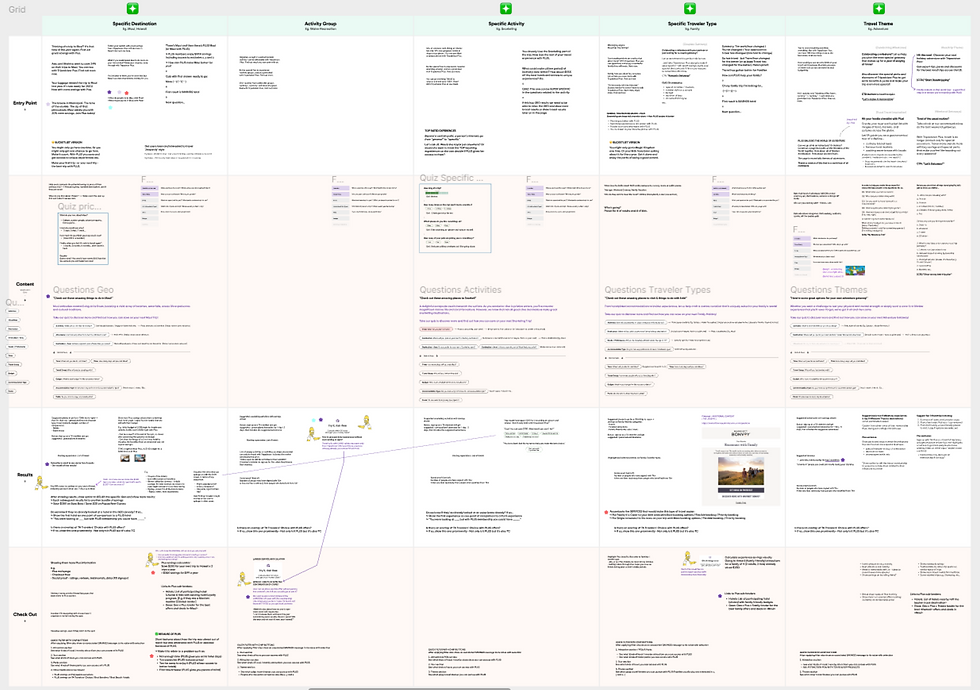
Collaborating with a colleague from the Creative Team, the three of us took speculative designs done by a third-party agency and brought them up to a suitable level of fidelity that made them viable for real-world use. We recommended content catered to the three angles the team leaders requested and remodeled the UI elements closely to Tripadvisor's design system while maintaining a premium tone for Plus.
Impact
Our designs established the primary navigation and information flow, dictating how travelers interact and experience Plus. The success of our proposal evolved the lander further, simultaneously acting as a sales pitch to encourage more hotel partners to come on board the program.
My role & My Team
While waiting for the official brief, I proactively identified component candidates from the Tripadvisor design library that could model the agency's designs without invasive changes. This sped up our design efforts later on when constructing the lander in high-fidelity. I also adapted the lander into mobile with different interaction styles.
Working asynchronously with the team leaders in the headquarters, we had the challenge of assimilating the direction of the lander on our own to promptly deliver designs accurately to their feedback and last-minute changes that arrived daily.

Plus Homepage Lander
I was assigned my first solo project in collaboration with a senior designer, a product director, and a colleague from the Creative Team. My challenge was to design two variations, one for travelers interested in Tripadvisor Plus and another depicting a flow that emphasized hotels. All with the ultimate goal of educating travelers more about the program and encouraging conversion. My solutions were approved for expressing clearly and more effectively the value proposition of the Plus program.
Impact
Catering designs for two variations made it more effective for Plus to meet different high-intent travelers with tailored messaging, removing friction and raising conversion rates. The three versions we recommended gave the project manager a proposition on the future state of the lander and eased engineering efforts as the versions can be developed in phases.
My role & My Team
I first dived into research archives to gather insights about the traveler's painpoints that could be addressed in this lander. Then, before designing the two variations, I examined the two flows to understand their similarities and differences. The foundation about how Plus worked stayed the same while the content was tailored to the two types of traveler intent coming in. Next, I proposed three design options with varying levels of engineering effort, from iterating the current content to presenting new modules.


My Reflections.
Being the ground of confidence for new products
New products have more uncertainties, and one must always be prepared and adaptable to changes. While it is easier to propose something different, one needs to be mindful of branding and the kind of impression/message it sends to users. At times, decisions are not finalized yet, so we as the designers may need to be the ones to illustrate a direction for the Project Manager to visualize and get a better sense of what could and should be done.
Understanding the design difference between new and mature products
Aside from Tripadvisor Plus, I also had the opportunity to work on optimizing some mature products on Tripadvisor, and it was both challenging and rewarding to experience both perspectives. I could see the fundamentals that stayed the same between them and the point where each would require a different focus to achieve the product’s objectives.
Our role as UX designers in the organization
I learned that we do more than simply design a module or optimize an existing flow. Many ingredients go into building a product, even throughout its unique history, that come to define what it is today. Being the ones designing the solutions, we see things, and we hold knowledge about them. That makes us bearers of truth and at times, voices for the other people working on the product. We need to know how to communicate all these strategically back into the organization to help stakeholders make better and more informed product and business decisions.